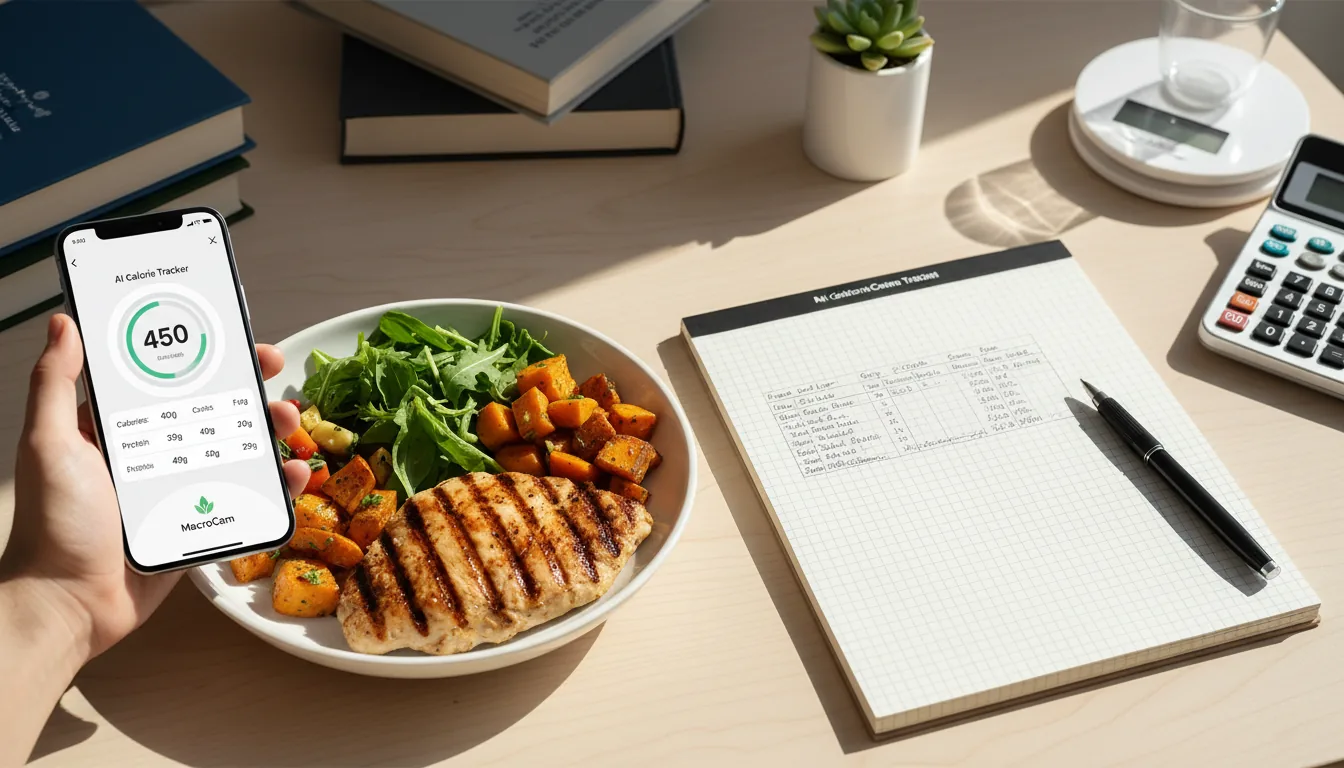
If you need a short answer: MacroCam is usually better for consistency because capture friction is lower (photo first, then review), while manual tracking can still work for users who prefer full hand-entry control.
For broader context on research numbers behind mobile logging, see Evidence-Based AI Calorie Tracking: 4 Numbers to Know.
MacroCam vs manual calorie tracking
| Category | MacroCam (photo-based logging) | Manual calorie tracking |
|---|---|---|
| Capture flow | Snap meal photo, get calorie and macro estimate, then adjust if needed | Search foods, estimate portions, enter items one by one |
| Typical time burden | Product target: nutrition info in under 2 seconds after capture | In one self-monitoring study, successful users averaged roughly 23-24 min/day early, then 15-16 min/day by month 6 |
| Adherence friction | Lower entry friction can make repeated logging easier | Higher repeated effort can reduce consistency over time |
| Data control | Fast default estimate plus user correction | Full manual control from the start |
| Best fit | Busy users who want fast daily adherence | Users who prefer fully manual entry and detailed custom edits |
Why this comparison matters for outcomes
Weight-management outcomes depend heavily on consistent self-monitoring. Mobile app interventions are repeatedly associated with modest but meaningful weight-loss effects in pooled analyses, which supports lower-friction logging workflows.
Evidence snapshot (primary sources)
-
-1.32 kg pooled effect across 261 studies (62,407 participants).
Citation (PubMed, 2025): Umbrella review -
-1.04 kg effect in a controlled-study meta-analysis of mobile app interventions.
Citation (Journal of Medical Internet Research, 2015): Controlled-study meta-analysis -
In an electronic dietary self-monitoring study, participants with stronger outcomes logged more consistently, with reported averages near 23-24 min/day in month 1 and 15-16 min/day by month 6.
Citation (PMC, 2019): Log Often, Lose More
Practical selection rule
- Choose MacroCam if your biggest blocker is logging friction and time.
- Choose manual tracking if you prefer detailed hand-entry and do not mind the extra effort.
- In both approaches, weekly consistency beats one perfect day.
Bottom line
MacroCam and manual tracking can both support progress, but they solve different constraints. If speed and daily adherence are your bottleneck, MacroCam is the stronger default. If granular hand-entry control matters most, manual tracking remains a valid option.