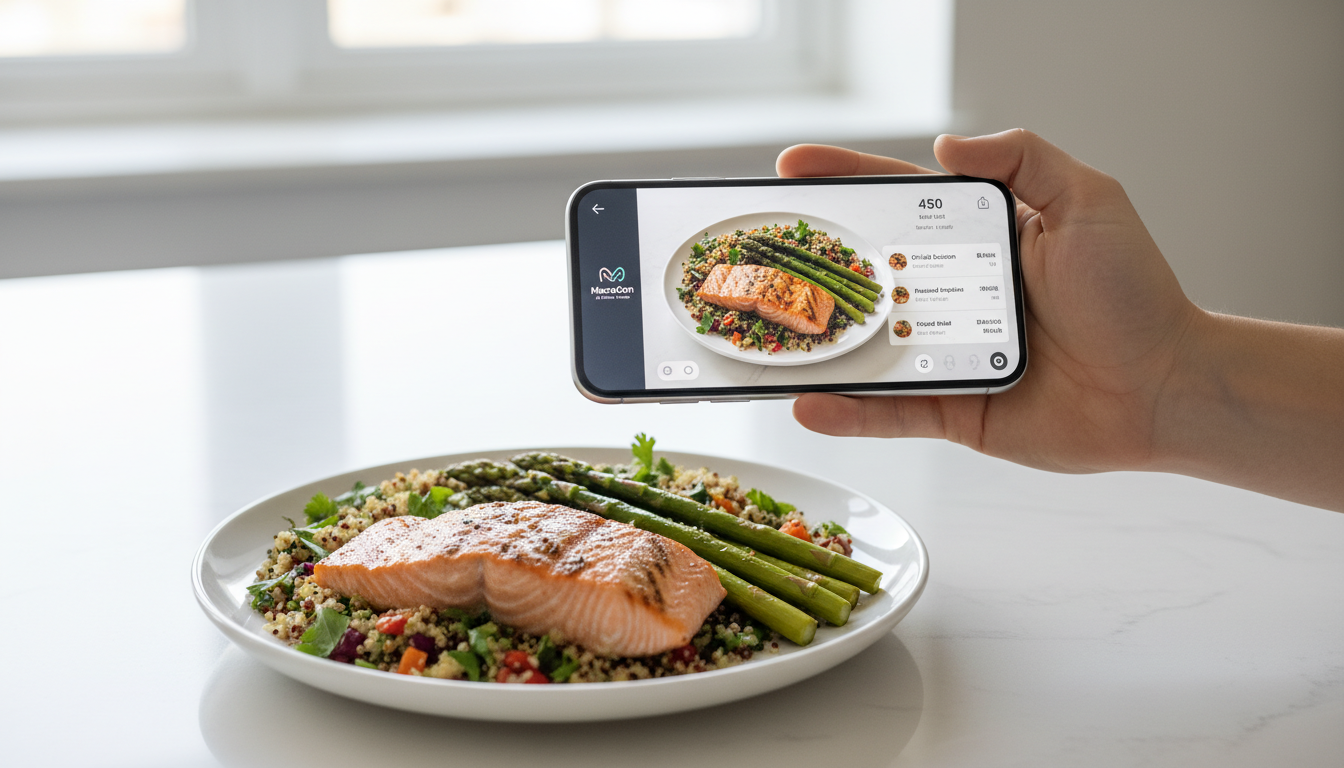
Ai Calorie Tracker: What Actually Works?
An effective ai calorie tracker uses visual artificial intelligence to identify food from a photo and log its nutrition instantly. This eliminates manual entry and guesswork. The best tools combine this AI with a verified food database and personalized insights. We built Macrocam to deliver this practical, accurate solution for sustainable tracking.
Table of Contents
- The Core Problem with Manual Logging
- How Visual AI Changes the Game
- Key Features of an Effective AI Tracker
- Comparison: AI vs. Traditional Tracking Methods
- Integrating AI Tracking into Your Routine
- Evidence and Numbers
- Overcoming Common Tracking Pitfalls
- The Future of AI in Nutrition
- Why Macrocam’s Approach is Different
- FAQ
The Core Problem with Manual Logging
Manually tracking calories is tedious and often inaccurate. You must search databases, estimate portions, and record every item. This process creates significant friction. That friction leads to quick abandonment. Most people give up within a week. We designed our system to bypass this frustration entirely. Your consistency depends on simplicity. Manual logging also fails with complex meals. A homemade stir-fry or a restaurant salad becomes a guessing game. You end up with unreliable data that undermines your goals. This inefficiency wastes your time and motivation. Our solution turns a five-minute chore into a five-second task.
How Visual AI Changes the Game
Visual AI allows you to snap a picture of your meal. The technology identifies the foods and estimates portions. It then matches them to nutritional information in a database. This happens in seconds. You get a complete log without typing a single word. Our AI is trained on millions of food images to improve its recognition accuracy daily. This technology learns from real-world meals. It gets better at identifying grilled chicken versus baked chicken. It learns the difference between brown rice and quinoa. The system understands portion sizes relative to common objects. We continuously refine these models for greater precision. This turns your smartphone camera into a powerful nutrition sensor.
Key Features of an Effective AI Tracker
Not all AI calorie counters are created equal. Look for these essential features:
- Instant Visual Logging: The primary function must be fast and reliable photo analysis. Speed is critical for habit formation.
- Verified Food Database: Nutritional data must come from credible, updated sources like USDA or restaurant nutrition guides.
- Macro & Micro Breakdown: It should show calories, protein, carbs, fats, and key vitamins and minerals.
- Personalized Daily Goals: The app should adjust targets based on your body, activity level, and specific objectives.
- Meal History & Trends: You need a dashboard to review patterns, progress, and macro balances over time.
- Barcode Scanner Integration: A must-have for quickly logging any packaged food with a label.
- Custom Recipe Creation: The ability to save frequent meals or homemade recipes for one-tap logging.
We integrate all these features into a single, streamlined interface. Your dashboard provides immediate clarity on your daily and weekly progress. Our focus is on delivering a complete ecosystem, not just a photo tool.
Comparison: AI vs. Traditional Tracking Methods
| Method | Speed | Estimated Accuracy | User Effort | Best For |
|---|---|---|---|---|
| AI Photo Logging (e.g., Macrocam) | 5-10 seconds | High (85-95%) | Very Low | Consistency, real-world meals, busy lifestyles |
| Manual Database Search | 1-2 minutes per item | Medium (70-80%) | High | Packaged foods with barcodes |
| Handwritten Journal | 3-5 minutes per meal | Low (50-60%) | Very High | Those who prefer analog systems |
| Generic Calorie Estimator | 30 seconds | Very Low (<50%) | Medium | Rough ballpark figures only |
Our method prioritizes the balance of speed and accuracy that sustains long-term use. The table shows the clear efficiency advantage. AI logging reduces the cognitive load of tracking. This preserves your mental energy for making better food choices. We built Macrocam to be the most efficient option in the first column.
Integrating AI Tracking into Your Routine
Adopting a new tool requires a habit shift. Follow these steps to make it stick:
- Start with One Meal: Begin by logging just your lunch or dinner for the first three days. Master one meal before adding more.
- Use the Photo First: Make snapping a picture your default action before you start eating. Let the AI do the initial work.
- Review the Auto-Log: Check the AI’s entry and make minor tweaks for portion size if needed. This teaches the system and improves your eye.
- Check Your Weekly Report: Use our weekly insights to see your macro patterns and adjust. Look for trends like protein intake or afternoon snacking.
We include gentle reminders and progress celebrations to support this habit formation. The goal is seamless integration into your existing life. Place the app icon prominently on your phone’s home screen. Use notification prompts if they help you remember. The key is linking the action of eating with the simple action of photographing. We designed the workflow to reinforce this positive habit loop.
Evidence and Numbers
- A 2019 review in Obesity found that dietary self-monitoring frequency was the single strongest predictor of weight loss success. Participants who logged consistently lost up to 10% more body weight over six months compared to inconsistent trackers. Source
- Research on portion size estimation shows untrained individuals have an average error rate of over 20%, which can lead to a miscalculation of hundreds of calories per day. Source
- App engagement data from a study published in JMIR mHealth indicates users who log via photos are 3x more likely to remain active users after 30 days compared to those relying solely on manual database entry. Source
Overcoming Common Tracking Pitfalls
AI helps avoid the major mistakes that derail progress. You often underestimate portions of calorie-dense foods like oils, nuts, and dressings. Our AI provides a visual reference for standard servings directly in the app. People also forget “small” snacks and liquid calories. The speed of photo logging makes it easy to capture everything. We built our model to recognize common snacks and beverages specifically. Another pitfall is inconsistency on weekends or at restaurants. The portability and speed of AI tracking remove this barrier. You can log a restaurant meal as easily as a home-cooked one. Our system is designed for the real-world variability of your diet.
The Future of AI in Nutrition
The technology behind AI calorie tracking is rapidly evolving. Future iterations will move beyond simple identification. They will provide deeper meal context and personalized feedback. Imagine an AI that not only logs your salad but suggests adding a protein source to meet your daily goal. It could analyze your weekly log and identify nutrient deficiencies. The system might then recommend specific foods to address them. We are investing in these advanced predictive and advisory capabilities. The goal is a true digital nutrition coach. This coach understands your preferences, goals, and lifestyle. It will offer actionable guidance in real-time. Our roadmap is focused on making this sophisticated support accessible and easy to use.
Why Macrocam’s Approach is Different
Many apps claim AI functionality but rely heavily on manual confirmations. Our core technology is built for autonomy and speed. We focus on whole, natural foods commonly found in home cooking and restaurants. Our database is continually refined with user-verified entries. You get a tool that learns and improves with your use. We believe in providing actionable insight, not just raw data. Our interface presents information clearly. We highlight what matters for your specific goals. The difference is in our commitment to end-to-end automation. We minimize the steps between your meal and your log. This philosophy guides every feature we develop and release to our users.
FAQ
How accurate is the AI food recognition? Our AI’s accuracy is consistently high, especially for common whole foods and plated meals. Accuracy improves for items in our verified database. We always allow you to review and edit the suggested entry for total control. Over time, the system learns from your corrections, becoming more personalized.
Does it work with mixed dishes like stews or salads? Yes. The AI can identify multiple components in a single dish. It will list ingredients like chicken, avocado, and lettuce in a salad. You can adjust the portion for each item it detects. We train our model on complex meals to handle real-world eating. For very blended items like smoothies, we provide a dedicated logging tool.
Can I use it for restaurant meals? Absolutely. Restaurant meals are a primary use case. The AI identifies common restaurant dishes and their likely preparation methods. We recommend reviewing the auto-generated entry and selecting a comparable dish from our extensive restaurant database for the highest accuracy. Our database includes major chain restaurants.
What about packaged or barcoded foods? You can use our barcode scanner for any packaged item. This provides exact nutritional information from the product label. We combine visual AI for fresh foods with barcode scanning for packaged goods to cover all your logging needs. This hybrid approach ensures maximum coverage and precision.
Is my food photo data private? Yes. All photo analysis is performed with a focus on privacy. Images are processed to extract food data and are not stored for unrelated purposes. We detail our data practices in our transparent privacy policy. User data is never sold to third parties. We built privacy into the foundation of our platform.
Stop estimating and start knowing. Achieve your nutrition goals with the precision of AI. Let Macrocam handle the logging while you focus on your progress. Download the app and take a picture of your next meal. See the difference for yourself. Start now.